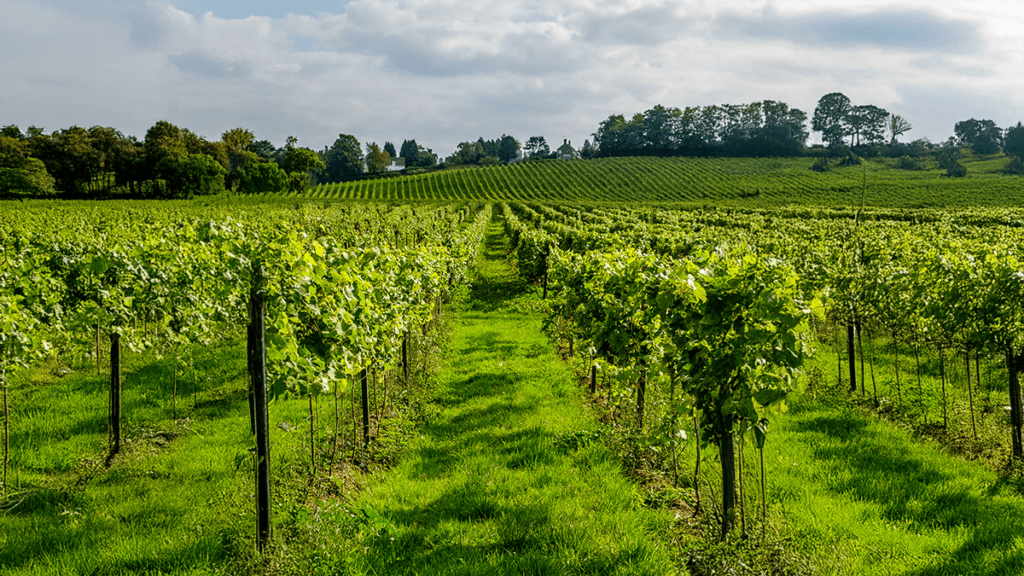
We’re proud to see one of our collaborative vineyard biodiversity projects, led by NIAB and funded by Growing Kent & Medway, being showcased at the Cool Climate Wine Symposium in New Zealand this month: a global event bringing together researchers, growers and industry leaders working in cool climate viticulture.
A poster presentation of our study will highlight to attendees the findings of a UK-based trial exploring how companion planting in vineyard alleyways can support invertebrate biodiversity, both above and below ground. It’s a great example of how robust field science, innovative monitoring techniques and cross-sector collaboration can deliver insights with international relevance.
A Collaborative Project Exploring Biodiversity Above and Below Ground
The project was funded by Growing Kent & Medway as part of a wider £50,000 research programme supporting sustainable innovation in UK plant-based food and farming, and delivered in partnership with NIAB through its Wine Innovation Centre.
Led by NIAB, the research set out to explore how companion planting in vineyard alleyways could help increase biodiversity, support soil health and contribute to more resilient vineyard systems. Chamomile (Matricaria chamomilla) was drilled between vine rows to deter pests and attract beneficial insects, while also supporting wider ecosystem function.
Field trials were undertaken at NIAB’s East Malling Research Vineyard and at commercial vineyards including Gusbourne Estate and Westwell Wine Estate in Kent.
To assess impact, the research combined traditional ecological survey techniques, such as transect walks and tap sampling to visually record insect activity, with belowground bioacoustic monitoring to capture the sounds of soil-dwelling invertebrates and monitor their activity levels.
Alongside companion planting, the team also applied chitosan, a natural plant protection product derived from mushrooms and crustacean shells. Acting as both a biostimulant and biopesticide, chitosan was used to help improve soil health and reduce disease pressure from issues such as vine mildew and rot. NIAB’s Wine Innovation Centre also assessed whether these regenerative approaches influenced grape quality and wine chemistry.
The Soil Acoustics team contributed to the project through supporting elements of the data collection and leading on the soil acoustics analysis. Using bioacoustic techniques, we were able to ‘listen’ to belowground invertebrate activity and assess soil biological activity in both companion-planted and control rows.
This work was carried out before the development of the Soil Acoustic Meter (SAM), but it played an important role in demonstrating how soil acoustics can be used alongside conventional field trials to add a new dimension to biodiversity and soil health assessments.
As Karthik, Database Developer at Soil Acoustics, explains, “This project shows how soil acoustics can support findings of parallel regenerative farming trials. NIAB’s rigorous methodology mirrors our own commitment to innovative, evidence-based research. As an emerging field, soil acoustics is now readily available to all types of growers, offering valuable information on the biological health of their soils.”
Results from the trial showed a clear increase in flower-visiting insects and natural enemies within chamomile-seeded alleyways, highlighting the short-term biodiversity benefits of companion planting. While this increase was not yet reflected in invertebrate populations on the vines themselves, something that can take several years to develop, the findings reinforce the value of habitat provision within productive landscapes.
Belowground, soil acoustic measurements indicated comparable levels of biological activity between treatment and control rows during the monitoring period, providing important baseline insights into how soil communities respond during the early stages of companion plant establishment.
What makes this project particularly exciting is how it helped shape our ongoing focus on soils. The trial demonstrated the potential of soil acoustics as a complementary tool for validating regenerative and biodiversity-focused farming practices, an approach that has since evolved into a dedicated soils and soil health offering.
Seeing this work presented at an international conference underlines the growing interest in practical, evidence-based approaches to sustainable viticulture and land management.
You can view the poster presentation that will be on display here.
You can read more about the project and its findings on the Growing Kent & Medway website.
Contact Us
We’re passionate about transforming soil health monitoring. If you’d like to learn more about this news or the Soil Acoustic Meter (SAM) and how it can support your land management practices, get in touch with us via info@soilacoustics.com or call +44 (0)1629 593 958.